When the vegetable garden has too much water: growing without drowning the roots
Soil can be fertile and full of life, yet remain too wet for certain crops. The solution is not always improving the growing medium: sometimes we need to change how we grow.
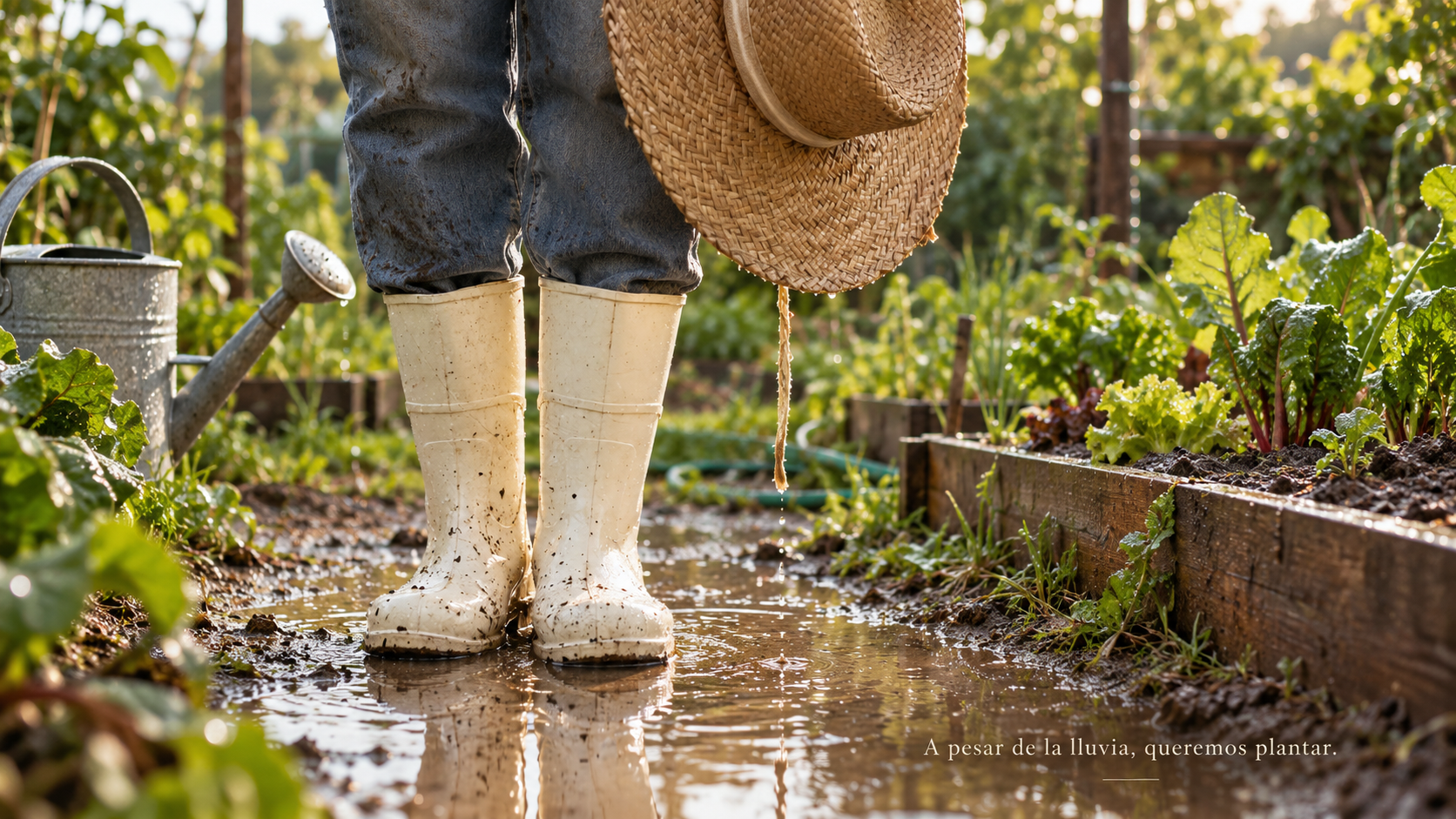
Soil can be fertile and full of life, yet remain too wet for certain crops. The solution is not always improving the growing medium: sometimes we need to change how we grow.
Some springs, the problem is not getting water. It is getting the soil to dry.
We sow, wait and see seeds germinating, yet some plants never fully emerge. Others come up but grow slowly, turn yellow or seem to stall.
Our first thought is often that the soil is not good enough. But that is not necessarily the case.
Fertile soil can also have aeration problems.
Roots need more than water
Plants need oxygen for their roots to function properly. That oxygen is found in the small spaces between soil particles.
When it rains too much and those spaces remain filled with water, roots may suffer from a lack of oxygen. If this continues, some plants stop growing and others develop diseases.
So before adding more compost or fertilizer, it is worth observing what is happening with the water.
Does the soil stay wet for several days? Are there places where puddles form? Do plants in one part of the garden grow better than those in another?
The ground may be telling us something important.
Not every part of the garden is the same
An apparently flat yard can have small depressions, slopes and places where water accumulates.
The height difference may be only a few centimeters, but water can behave quite differently.
That is why one of the first tasks should be observing the ground after rain.
Not only where water stays, but how long it remains there.
In places that take a long time to dry, growing directly at ground level may be difficult for species sensitive to waterlogging.
Raised soil ridges: lifting the garden without building boxes
One long-used solution is to form small raised ridges or mounds of soil, known as camellones in Spanish.
They do not need legs, boxes or expensive structures.
They are made by gathering soil to raise the growing area, with gently sloping sides. Paths or lower spaces are left between them so water can move through.
The idea is simple: keep a significant portion of the roots above areas that remain too wet.
The height needed depends on local conditions. There is no universal measurement for every garden.
Raising the soil also does not solve a serious drainage problem by itself: excess water needs somewhere to go.
What if we bury logs beneath the garden?
Another possibility is Hügelkultur, a technique using wood and organic matter to build growing mounds.
As the wood decomposes, it contributes to organic matter formation and can store moisture.
That ability is useful in certain environments, particularly when we want to conserve water.
But what happens if we use it on ground that already stays wet?
The answer depends on how the bed is built, the soil, water movement and how long the site stays saturated.
We also need to consider that wood loses volume as it decomposes. The ground may settle unevenly and need additional soil.
Hügelkultur is not a universal solution. It is a tool to choose according to growing conditions.
Should we cover the soil with plastic?
Agricultural plastic mulch can reduce weed growth, change soil temperature and limit rain entering the covered areas directly.
But it also reduces evaporation.
On ground that stays too wet, it should not be used without first evaluating drainage.
In some crops, it can be useful together with raised soil ridges. In others, a different covering or allowing the soil to lose some moisture will be more suitable.
Before building, observe
When a vegetable garden has problems with excess water, it is worth starting with a few simple decisions:
- Identify the places that remain wet longest.
- Avoid working or walking on soil when it is soaked.
- Observe whether water drains away or remains trapped.
- Consider raised soil ridges or low raised beds where needed.
- Choose better-drained places for the most sensitive species.
- Maintain organic matter and protect soil structure without preventing aeration.
We do not need to transform the entire garden at once.
We can try a small raised area, compare it with growing at ground level and observe what happens after rain.
The best garden is not always the highest
Not every garden needs raised ridges, and not all moisture is harmful.
A vegetable garden needs water, but also air, nutrients, suitable temperatures and soil where roots can develop.
The aim is not permanently dry soil.
It is soil that can receive water, use it and regain its air spaces.
Sometimes, before choosing what to plant, we need to learn to look at where we are planting.
Tools and materials to put it into practice
If you decide to raise a growing area or work the soil, here are two options to explore:
- Galvanized metal raised bed with rounded ends. An option for creating a raised growing area. Before installing it, check its base and how water will leave: a raised bed does not replace drainage.
- Tramontina garden fork. For working and aerating soil when conditions are suitable; avoid disturbing it while it is soaked.
These links lead to Mercado Libre products recommended by Qué Plantar. They may earn the project a commission at no additional cost to the buyer.
Related Articles
How to save tomato seeds for next season
How to extract, clean, dry and store tomato seeds for sowing again: a simple process with daily observation and tips for keeping them.
Hanging tomatoes: from toast in Spain to a question for our garden
A reader in Spain introduced us to penjar tomatoes: how they are stored, what makes them different and what growing them can teach us.

Covering the soil changes everything: why to mulch your vegetable garden
An organic soil covering improves water retention, moderates root-zone temperature and encourages microbial activity.
How to keep your lettuce tender through spring and summer
Is your lettuce turning tough or bitter? Learn how to water it, protect it from heat and harvest a little at a time.