How to tell if a plant needs a bigger pot
A plant can be healthy and still have run out of room. Learn to recognize the signs that it is time for a larger pot.

You care for it, water it and look at it every day, yet feel something has changed. It is there, alive, but no longer growing as before. Sometimes it hurts a little to think we might be doing something wrong, when the plant is really asking for something very simple: more room to keep growing.
Sometimes a plant is neither sick nor poorly cared for. It has simply run out of space.
It may stay green, produce a new leaf and look fairly well, but something has changed: growth is slower, the growing medium dries immediately or the roots start looking for a way out.
Before adding fertilizer, changing the watering or trying solutions, it is worth looking at something much simpler: the pot.
1. Roots start coming out of the bottom
This is one of the easiest signs to recognize.
If you see roots emerging through the drainage holes, they have occupied much of the available space and are looking for somewhere to keep growing.
A single root does not always mean you need to repot immediately. But if several appear and you notice other signs too, it is worth checking.
2. The soil dries much faster than before
You used to water every several days, and now the pot seems to dry immediately.
This can happen because the container holds so many roots that little growing medium remains to store moisture.
The plant takes up water, the small volume of soil dries quickly and you end up watering more and more often.
So a plant asking for water frequently does not always need more watering. Sometimes it needs more space.
3. The plant has stopped growing
This sign can be confusing because the plant may look perfectly alive.
Its color is good. You water it. It receives light. It does not look sick.
But weeks go by without progress.
When roots are extremely cramped, above-ground growth may slow too.
That brings a very common temptation: adding fertilizer.
But if the real problem is that the roots have nowhere to develop, more nutrients will not address the cause.
4. You take the plant out and see almost nothing but roots
If you are still unsure, this usually makes things much clearer.
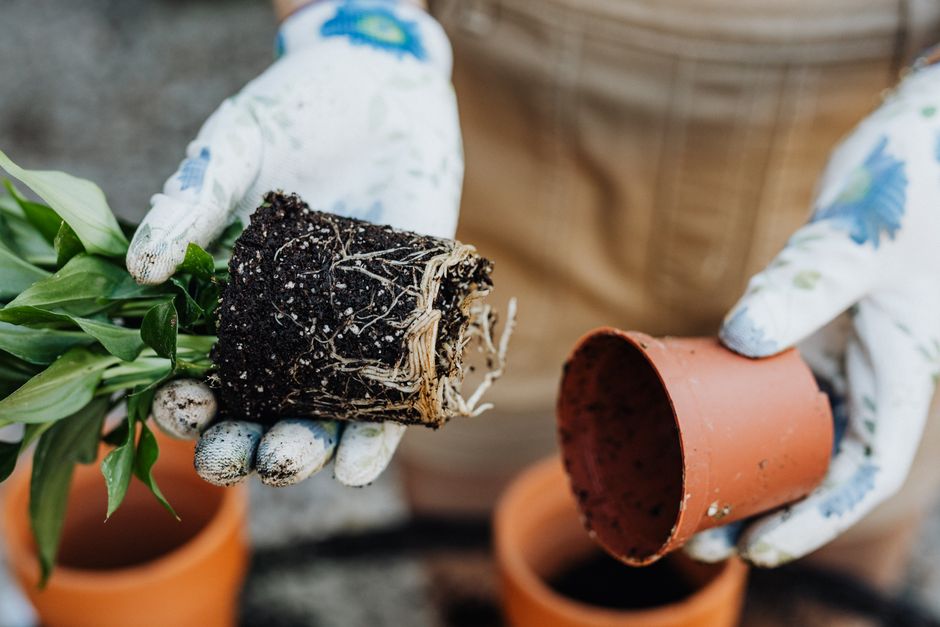
Gently support the plant and slide the root ball out of the pot.
If it keeps the exact shape of the container and you see a very dense network of roots around it, it probably needs more room.
In advanced cases, so little growing medium may be visible that the whole pot seems to have turned into roots.
5. The roots are growing in circles
When they reach the container’s edge and find no new space, some roots begin circling the root ball.
A small amount should not alarm you.
But if you find several coils packed on top of each other, repotting may help the plant expand again.
Should you move it to an enormous pot?
No.
And this part matters.
Choosing a much larger pot does not necessarily do the plant a favor.
Too much growing medium around a still-small root system can stay wet for too long and make watering difficult to manage.
The idea is to increase the size gradually.
Choose a pot just a little bigger than the previous one, enough to give the roots new room without turning the container into a pool of wet soil.
If you also want repotting to improve how the plant looks in the room, you can choose a decorative pot suited to its new size.
Beyond appearance, what matters is that water can drain properly.
Look at the roots before replanting
Repotting is an excellent opportunity to check something we do not normally see.
Healthy roots usually feel firm.
If you find soft, very dark or deteriorated areas, this is not only a plant needing a bigger pot. Excess moisture or drainage may also be a problem.
Carefully remove clearly damaged parts before replanting.
Should you loosen the roots?
If the root ball is very compact, you can gently loosen the outside with your fingers.
There is no need to pull it apart completely or tear off roots for no reason.
The aim is simply to help some roots that were circling the old pot start exploring the new growing medium.
Take the opportunity to refresh the growing medium
Repotting is not only about adding space.
It is also a chance to give the plant fresh growing medium with good structure and the ability to retain water without staying permanently soaked.
For houseplants, you can use a mix prepared specifically for this type of growing.
See growing medium for houseplants.
If your mix needs more organic matter, you can incorporate an appropriate amount of mature compost, according to the plant’s needs. Compost supplements the growing medium but does not replace it entirely.
You do not need to change every bit of soil clinging to the roots. If it is healthy, you can keep much of the original root ball and fill around it with fresh mix.
After repotting
Water until the new growing medium is thoroughly moistened and excess water can drain from the bottom.
Then let the plant adjust.
There is no need to fertilize immediately just because it has been repotted. First, it needs to settle its roots into the new space.
Over the following days, watch the moisture in the growing medium: with more soil volume, it probably will not need water at exactly the same frequency as before.
What if I do not want it to keep growing?
That can happen too.
Perhaps it has reached the size you want for that corner of the house, or you simply do not want increasingly large pots.
Some plants can be kept at a manageable size by replacing part of the growing medium and carefully managing the roots instead of continually moving them into larger containers.
Not every plant has to grow indefinitely.
Before changing the pot, check these five things
Roots coming out of the bottom. Growing medium drying much faster. Growth stopping. Roots circling the root ball. Very little soil visible between the roots.
One sign alone may not tell you much.
Several together tell a rather different story.
And that may be the most useful part of learning to observe a plant: not immediately reacting by adding water, fertilizer or products.
Sometimes the plant is not asking for more.
It is asking for room.
Contains affiliate links.
Related Articles
How to replant in the same pot without emptying the soil
Learned how to renew your potting soil and choose what to plant next without emptying the container.

Covering the soil changes everything: why to mulch your vegetable garden
An organic soil covering improves water retention, moderates root-zone temperature and encourages microbial activity.
Why Your Plant Isn't Growing and What You Can Do to Help
Has your plant looked the same for weeks with no new growth? Check light, roots, watering, and soil before adding fertilizer.